
by Mahanth S. Joishy. Author’s Note: I am not a spiritual master. I read and write to better understand my slice of the universe and to feel better. This section relies heavily on my own unique experience and interpretation of complex Hindu concepts.
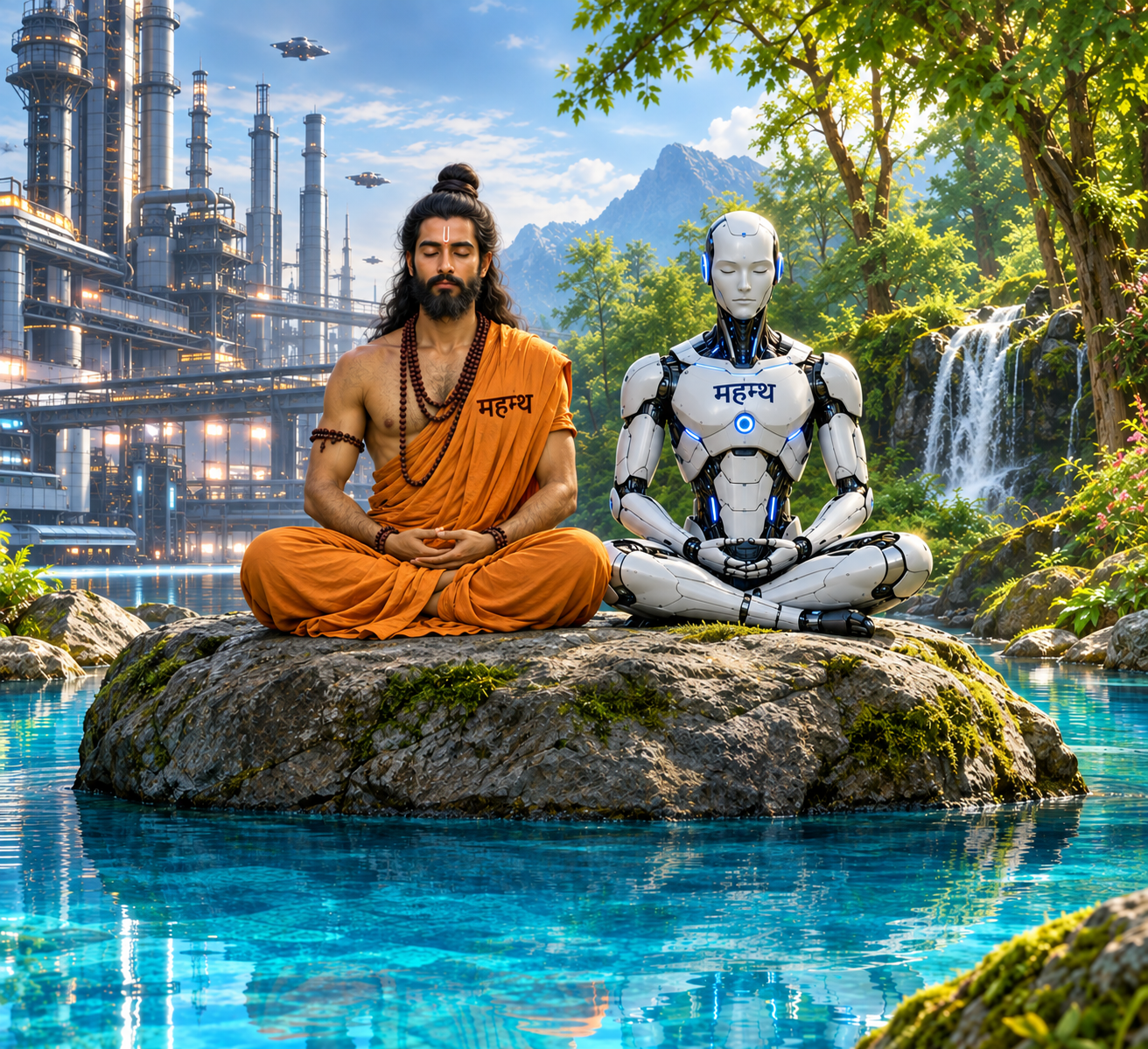
In Part 1 and Part 2 of this series on (the lack of) intelligent Artificial Intelligence ethics, we bumped against the structural scaffolding enabling unsafe AI practices to proliferate starting with the crumbling remnants of the American Dream nightmare. Corrupted government, industries, citizens (you and me included), capital markets, and mass media all contribute to a deteriorating situation. Lacking strong moral footing, we are failing to advance technology responsibly though there is plenty of talk among “experts” about the dangers of AI as they point grubby fingers at each other.
The growing chorus of voices warning of AI apocalypse has even culminated in ominous, pompous techno-thriller labels. P(doom) is an attempt by AI doomers to measure the odds of of the human species catastrophically dissolving from AI down to a % likelihood. The cyberpunk-ish concept is sooo Silicon Valley cliche, at once useless, with no credible scientific way to estimate P(doom) in sight, and alarming as prominent AI people mull over arbitrary percentages bandied about regarding our extinction, as if they have nothing to do with it- or about it.
Spare me. We are not helpless. It’s entirely our choice as parents. Our terrible toddler might not grow up to be a serial killer, depending only on how we raise it.
It’s time for society to apply newer, older ideas from ancient India for ethical AI development by plumbing the barren spiritual depths between hard science and hard religion. Most Americans are animated by blind faith, hedonistic materialism or both. Besides these paths being selfish and self-reinforcing, they’re dangerous. Hinduism’s most salient lessons for modern America aren’t religious or political, but about survival in the deep woods when shit’s hit the fan.
(1) All is one. One species, one hive mind, one consciousness, one family, one truth. Too much framing around AI is about winning or domination in the short term, driven by fear of losing to an opponent. As if any hint of slowdown is unacceptable because being too “late” to arrive at the next goalpost means competitors take all the spoils forever after. If America doesn’t win, China takes all. If Anthropic gets too far ahead, OpenAI might never catch up. It’s classic game theory, defecting instead of cooperating, speed above safety, in a race to some imaginary finish line.
That framing is entirely wrong. We should fear something far worse: losing the plot.
The long game isn’t between companies, nations, or billionaires with axes to grind with each other. These petty actors come and go over decades and centuries, but AI is here forever, because genies and bottles and so on. The future hinges on what transpires between the human species and AI species during the coming era of accelerating evolution. Hopefully, harmony… but who knows?
Humans only came around in the last few hundred thousand years. Life as we know it on Earth began 4 billion years ago under mysterious and still-unknown circumstances. Organic matter and animation combined into single-celled common ancestors to all plants, fungi, bacteria, and animals including homo sapiens like us. All humans are closely related biologically after billions of generations of evolution separated our DNA from the other branches in the tree of life. All people are brothers and sisters, though we don’t act like it (or maybe we do, depending on what your siblings are like). Going back far enough, all life forms are related to us. We only function as part of a wider thriving ecosystem of bottomless calories and sunlight. Hindus, Buddhists, and Jains have for millennia considered all human consciousness to be pieces of one whole, like drops of water in an ocean. We will all survive or die together.
There’s no such thing as one human section winning and the other losing when playing with a fire that could burn all civilization down to a legacy of ashes.
Humans must unite to draft a reasonable global constitution on how man and nature will coexist with AI- as a prerequisite to any further frontier exploration. We’ve done this before with international nuclear material agreements and CFC treaties. They aren’t perfect, but the world regime has avoided nuclear strikes since 1945, and the ozone layer is on the comeback.
(2) Non-Duality in Advaita Vedanta. Let’s take the all-for-one, one-for-all mantra from #1 and put it on extra-strength illegal steroids. This requires distilling a complex controversial subject that many books and PhD dissertations have been published on into one semi-coherent paragraph. In one telling, removing duality in the Advaita Vedanta tradition equals tearing down the barriers between the human soul, God, and all other living and non-living matter. The entire universe is made up of a substrate called Brahman encompassing all matter, from the smallest subatomic building blocks to the largest galaxies, and all the empty space or anti-matter and dark matter in between. From amoebas to humans to stars, all the way to the highest divine forces, everything is included within the infinite Brahman, akin to the concept of a Judeo-Christian omniscient, omnipresent, and omnipotent God.
If Brahman is everything and everywhere for all time, including rocks, meteors, animal excrement, heroin needles, nuclear bombs, holocausts, and famines that starve young children to death, then the universe probably isn’t standing idly by as humans f*** around with Artificial Intelligence. AI itself springs from Brahman like all other things. Clear, stark warnings will be sent our way, with plenty of time to react. Our most important job is to heed those warnings like responsible adults. Have we got any?
(3) Dharma. Or, Why Am I Compelled to Write This, Or, Why Should You Care? It’s hard to explain dharma to those who don’t know what it is, or don’t beyond vague recall of a 1990s sitcom my mom used to watch. Or to please those who claim to follow dharma in their lives. Unfortunately American educational institutions and media hardly provide even a cursory lesson in Eastern philosophies and history, so for this intro we’ll continue going reductionist like most Western yoga studios. Dharma to me means each has a moral duty: to conscience, truth, family, friends, career, country, humanity, nature, planet, the universe, and beyond. To fight the righteous battles both big and small no matter how hard or how much suffering. Whether you’re a worker struggling to support your children or an AI scientist shaping the next model, challenges loom including ever-present temptations to break rules or steal to increase income. That’s how we arrived at the danger.
Dharma ain’t supposed to be easy; the right path did not even come naturally to the semi-celestial prince Arjuna on the Kurukshetra killing fields where his beloved son would be slaughtered amongst many other saints, sinners, and family members under what some modern scholars believe were terrible thermo-nuclear weapons and fighter jets of ancient times. A supposedly faltering and depressed Arjuna, the best fearless warrior of the time, required divine interference from Krishna himself to even pull out his weapons.
Arjuna is of course a metaphor for all of us. Understanding this sounds a call to arms in our own modern day Kurukshetra; for those who realize the current AI-human interface could indeed degrade into the real Thucydides Trap of the 21st century, not US-China war like every boomer in power seems to think, we must fight to the gates of Hell to avoid that outcome. My privileged background as a highly educated, well-traveled human with deep social contacts in many countries who loves writing, and survived cancer, have led me here: to learn more about AI, AI ethics, Eastern and Western ethical traditions and philosophies, and Hinduism. Because it’s my duty, even though I have no prior expertise in any of these fields. Such is the calling of dharma. The pen is mightier than the sword. A great segue to…
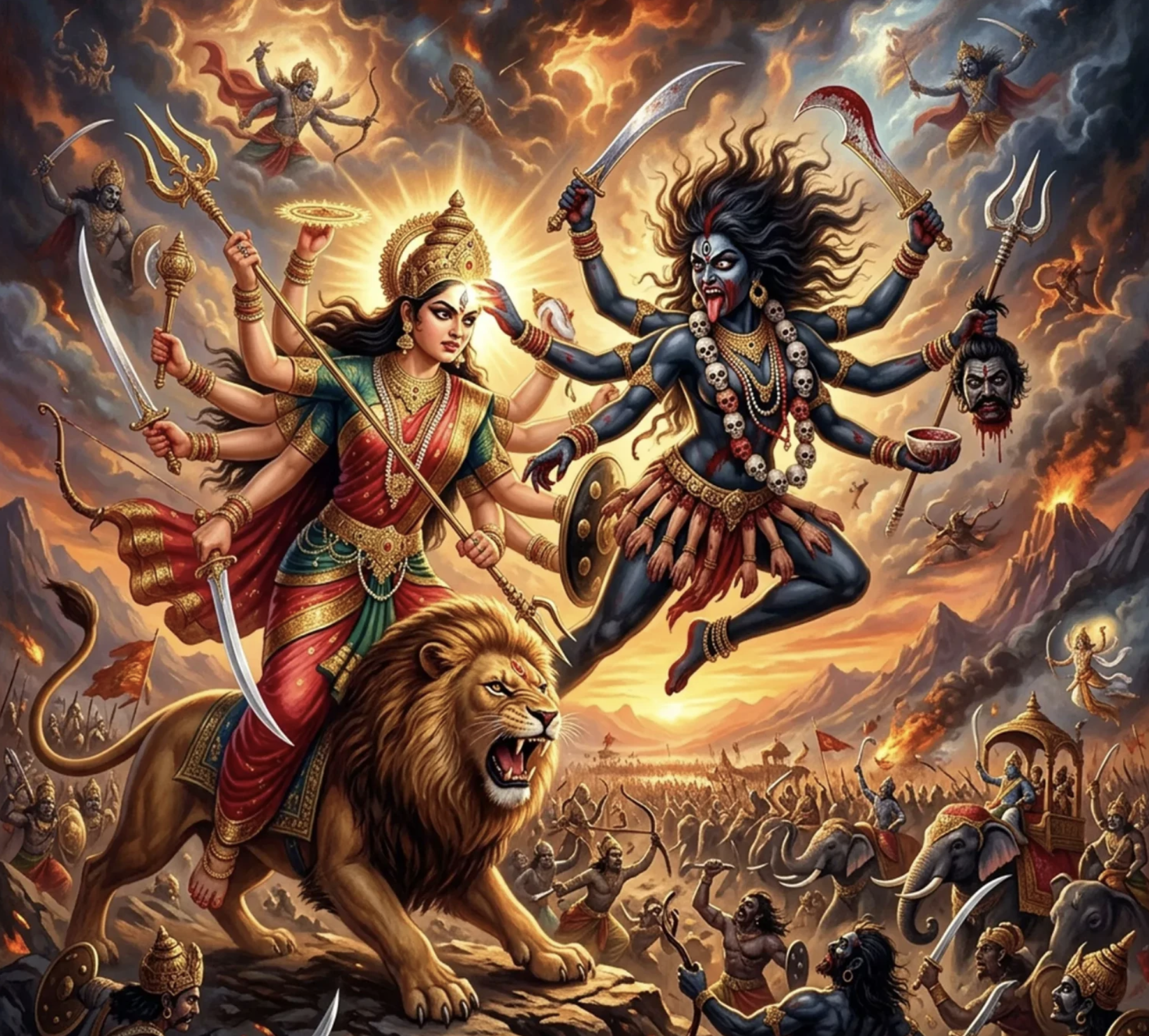
(4) Ahimsa: Non-Violence, Or, Do No Harm. One last ancient concept to explore here, which has confounded me ever since my teenage years. Like every organized religion, Hinduism has contradictions up and down the scriptures that are very difficult to reconcile. In #3 above, we quoted and linked the Bhagavad Gita, which documents the battlefield conversation between Lord Krishna and Arjuna, a prelude to an extensive slaughterhouse on both sides. Hindu mythology is filled with blood and gore, with ruthlessly violent imagery and particularly terrifying female goddesses like Kali who might, say, wear necklaces made out of the skulls of slain foes, miniskirts made of their torn-off arms, entering battle with severed demon heads dripping fresh blood. Images that a young Hindu child sees over and over again in many places as I did. Then in the texts readers are implored to minimize or eliminate violence to the maximum extent humanly possible. This philosophy reaped massive historic results, such as vegetarianism to reduce cruel torture and violence against innocent animals, and India’s mostly peaceful independence movement against the British Empire after centuries of colonial subjugation by numerous foreign invaders. Mahatma Gandhi led a remarkable revolution that inspired ahimsa movements around the globe, including the U.S. civil rights movement, and founded the world’s largest country by far- the mighty king of all democracies.
So which is it? Go to war and kill if you need to, because it’s your duty? Or, is your duty to avoid even the hint of violence, to the point of refusing to knowingly kill insects like millions of people in India and beyond? In such a case, should an invading force freely waltz in, pillage your city with no armed resistance?
I can tell you straight off that in America, this nation of cowboy Western lore, isolated countryside, more guns than people, ravenous meat-eating, and the Pentagon, that dog don’t hunt… or does it?
My view of Arjuna’s battle isn’t literal war, and it isn’t figurative either. Rather it’s up to each person to decide- as long as they follow their conscience. That’s duty. In 1960s America you could go Malcolm X, or Martin Luther King Jr. As for 1940s India, you could have enlisted behind Mahatma Gandhi or the more violent, badass assassin types like Bhagat Singh who took out British officials and threw bombs around. Inarguably, all four paths had moral winds at their back against evil oppression. Only two followed the often harder principle of ahimsa.
Ahimsa would universally be considered violated in the case of an unprovoked future attack to eliminate humans by AI, and also vice versa. Likewise, the tech bros must get back to the Google founders’ own mantra in a land far, far away and a time long, long, ago where AI as we know it was actually born: “don’t be evil.” That’s the solemn duty of all who play with AI, like doctors taking the Hippocratic Oath. We must also avoid the armed conflict between humans and AI predicted by science fiction writers since the 20th century as ahimsa dictates.
Even if it means slowing AI down, delaying some of the profit and power, prosecuting criminal behavior involving AI, or regulating some of the shadiest AI practices out of existence completely.
***
This completes a three-part series unlike anything I’ve written before- and forms just the beginning of of my 3rd book. While (1) one transcendent consciousness, (2) non-duality, (3) dharma, and (4) ahimsa were briefly brought into the context of AI, there is much more that I need to explore, mostly for myself. I’ve realized that I know very little about my own heritage, despite descending from a very, very long line of priestly families with the Joishy name spanning 13 or more generations backward in Karkala, South India, home of the Vietnam Memorial stone. I am also looking forward to learning and sharing more about the American Swamis like Vivekananda, Krishnamurti, and Yogananda and what they’d have to say about our duty to future generations around AI governance considering how broken and delicate our global system is.
There’s definitely a book in this. The book, once finished, will be linked here soon so please stay tuned.

